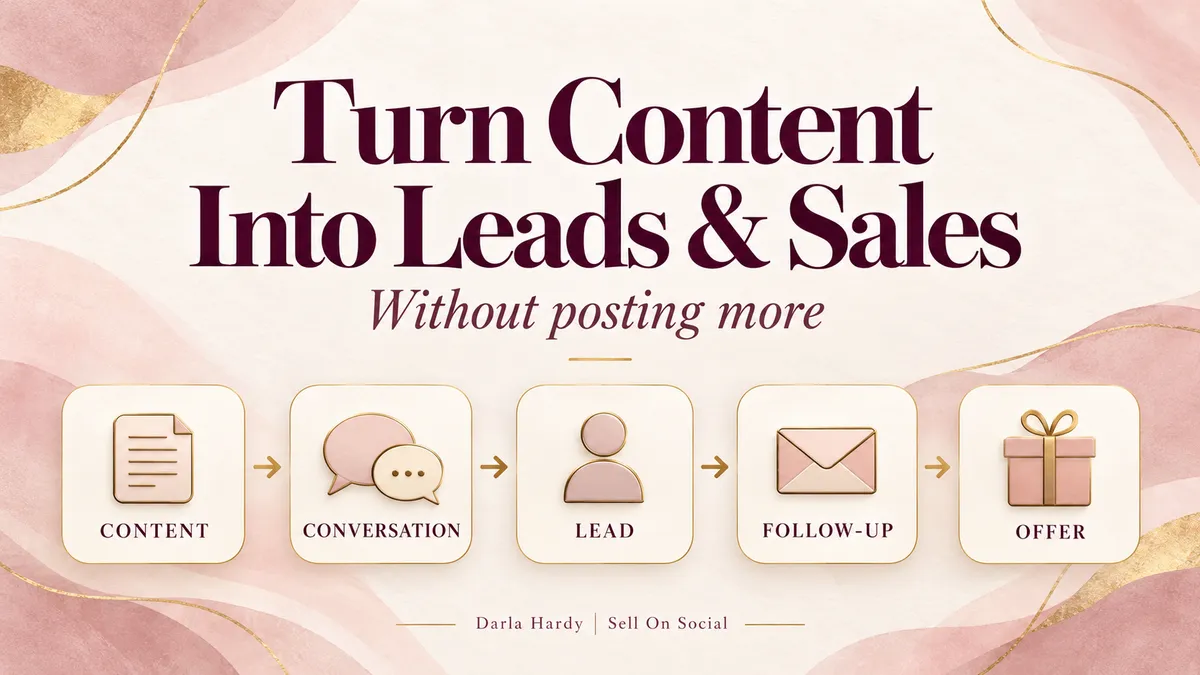
Turn Social Media Content Into Leads & Sales
How to Turn Social Media Content Into Leads and Sales—Without Posting More
You’re creating content. You’re showing up on social media. You may even be getting likes, comments and new followers.
But those people aren’t consistently becoming leads or customers.
The natural reaction is to assume you need to post more. More Reels. More Stories. More tips. More offers.
Before adding more content, look at what happens after someone sees what you already share. Your content may be attracting attention without giving interested people a clear way to move forward.
A post can introduce someone to your business. A connected social selling system helps you continue the relationship through conversations, useful resources, follow-up and a clear offer.
Let’s build that path.
Content Is the Beginning of the Relationship
Social media content helps the right people discover you and understand why they should keep paying attention. But someone who enjoys one post may still need time to understand your approach and decide whether your offer fits her needs.
Your content can help her:
Recognize that you understand her problem
Learn something useful
Get to know your approach
Build trust in your ability to help
Understand what you offer
Choose a next step when she is ready
If your posts never offer a next step, interested people may enjoy the information and continue scrolling. Give them an invitation that fits the content and their level of interest.
A Simple Path From Content to Customer
Think of your system as five connected pieces:
Content → Conversation → Lead → Follow-Up → Offer
This is a planning framework, not a rigid sequence every customer must follow. Some people will message you first. Others will download a resource directly or visit your offer page.
The goal is to make those routes easy to find and follow.
Step 1: Create Content With a Purpose
Before creating a post, ask:
What do I want this content to do?
A post might help new people discover you, teach something useful, challenge a common belief, build trust through a personal story or invite someone to explore an offer.
Give each piece of content one primary purpose. It does not need to teach, inspire, explain your entire program and make a sale all at once.
For example:
A short Reel explains why a large following is not the only factor in making sales.
A carousel highlights three missing connections between content and leads.
A personal story shares a real lesson from building your business.
A resource post invites readers to download your free Sell On Social Starter Kit.
These posts can work together to help people understand your message and choose their next step.
Step 2: Give People a Clear Next Step
People should not have to guess what to do after reading your post.
Your call to action could invite them to:
Answer a question
Send you a message
Join your Facebook community
Download a free resource
Read a related article
Explore your offer
Match the invitation to the purpose of the post and the relationship you have with the reader.
Someone discovering you for the first time may be ready to ask a question or download something helpful. Someone who has followed you for months and asked about your program may be ready to review the offer.
If you invite people to comment with a keyword, make sure you have a reliable way to deliver what you promised and respond to their interest.
The invitation starts the conversation. Your response continues it.
Step 3: Turn Interest Into a Lead
A follower is not automatically a lead.
A lead is someone who has expressed interest in what you help people do—for example, by asking about your service or requesting a relevant free resource.
An email list gives you another way to stay connected beyond someone’s social feed. When people choose to subscribe, you can deliver the resource they requested and continue sharing useful guidance.
A good lead magnet solves a small, immediate problem that connects naturally to your paid offer.
For someone who feels unsure about social selling, a complete program may feel like a big first step. The Sell On Social Starter Kit gives her a smaller place to begin before exploring more training.
Make that first step easy: explain what she will receive, how it can help and what emails she can expect afterward.
Step 4: Follow Up After the Download
Delivering the resource is the beginning of follow-up.
Your emails should help the subscriber:
Access and use the resource
Understand the problem it begins to address
Learn more about your approach
Take another useful step
Consider your paid solution if it fits her needs
You can share an implementation tip, a common mistake, a real example, an invitation to reply or a related free training.
For my audience, the next learning step is the free 4D Roadmap mini course, followed by an introduction to Sell On Social.
Each email should have a reason to be there. Help the reader use what she requested, answer likely questions and understand her options without overwhelming her.
Step 5: Make Your Offer Clear
When you introduce your program, explain:
Who it is for
What problem it addresses
What is included
What it helps the person learn or implement
How to get started
Avoid assuming people know what you sell because you mentioned it several weeks ago. Some readers are new. Others may have seen only a few of your posts.
Repeating a clear offer helps people understand whether it fits their needs.
Sell On Social brings together Strategy, Content and Growth with two ways to participate:
Self-paced — $147: Access to the Sell On Social bundle to work through and apply independently.
Personal Guidance — $444: The bundle plus three private, 45-minute guidance sessions to help you apply the material to your business.
Both options provide the program. Personal Guidance adds individual support with implementation.
What This Looks Like in Practice
Imagine a post titled:
“Three reasons your content is getting likes but not leads.”
It explains three possible gaps: an unclear audience, a missing next step and no follow-up after someone expresses interest.
At the end, you invite readers to download the free Sell On Social Starter Kit.
After signing up, they receive:
The Starter Kit
Guidance on using it
An invitation to the free 4D Roadmap mini course
Follow-up that introduces the complete Sell On Social program
Now the post connects to a next step. You also have opportunities to answer questions and help readers decide whether your program fits their needs.
That connection gives your content a business purpose beyond collecting reactions.
Measure What Happens After the Post
Likes and views tell you something about attention. Also look at actions that show interest:
Relevant comments and direct messages
Link clicks
Starter Kit registrations
Email clicks and replies
Mini-course enrollments
Purchases
Track these over time so you can see where people move forward and where they stop.
A post that brings a few interested prospects into your system can be useful even when its view count is modest.
Ask whether the people responding are a good fit for what you offer, too. More registrations alone do not tell you whether your message is reaching the right audience.
Build the Path Before Adding More Content
Before increasing your posting frequency, ask:
Is it clear who my content is for?
Does each post have a purpose?
Can interested people find a logical next step?
Does my free resource connect to my paid offer?
Does my follow-up help people use the resource and learn more?
Is my offer easy to understand?
Choose one missing connection and improve it first.
Add a relevant invitation to a useful post, strengthen your delivery email or clarify the difference between your program options.
You can improve the path using content you already have.
Start With the Sell On Social Starter Kit
If you’re unsure what should happen between posting content and presenting an offer, start with the free Sell On Social Starter Kit.
Use it as your first step, then continue learning with the free 4D Roadmap mini course.
GET THE FREE SELL ON SOCIAL STARTER KIT HERE
You do not need to become someone else to sell on social media. Start with a clear message, useful content and a next step that helps interested people move forward.


